Your heater runs but the house never warms up. Hot water drops off mid‑shower, too. That’s when you start to blame the appliances.
But what if they’re just fine? The problem could be undersized gas pipes. And that’s why knowing how to calculate gas pipe size matters.
This guide covers the key variables and how AS/NZS 5601.1:2022 guides the process. Some of it is fiddly, which is why a licensed gas fitter in Melbourne should handle the installation. Keep reading!
Gas pipe size controls gas delivery. Too small, and the pipe restricts flow. Too large, and you have to pay for extra material, extra labour, and pipework bulk the job never needed.
Most Melbourne homes on mains natural gas work around a low-pressure supply. Energy Safe Victoria guidance refers to standard natural gas installations operating around a nominal 1.13 kPa supply pressure.
That’s a tiny amount of pressure. Any restriction from a small pipe causes an immediate problem.
Undersized pipework often shows up in frustrating ways around the house:
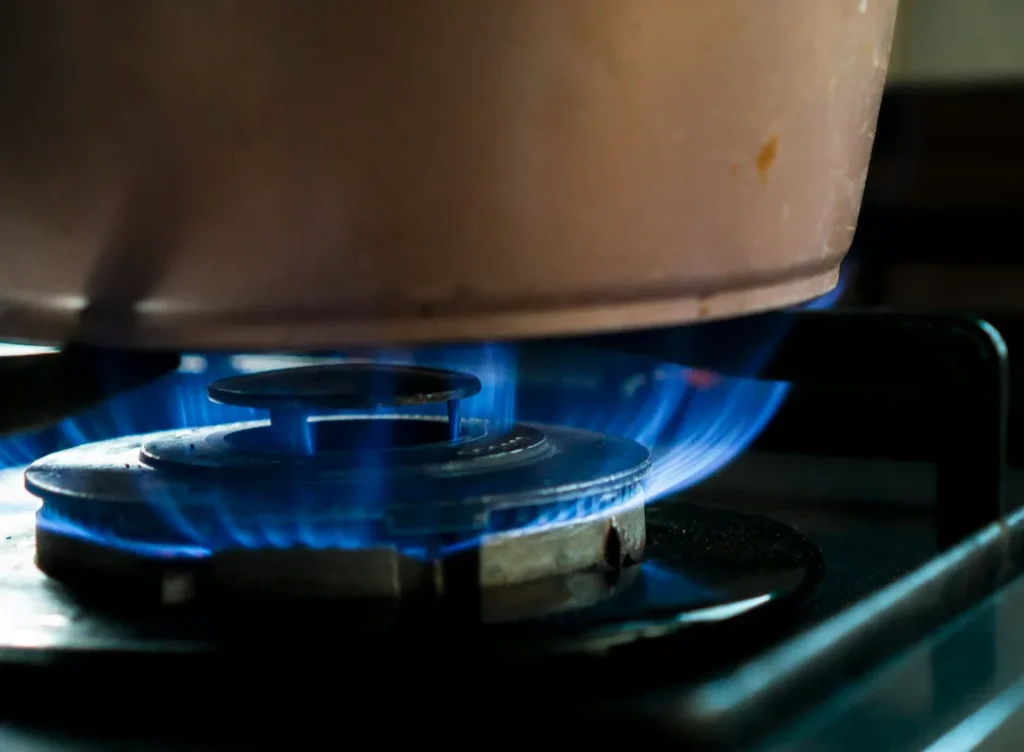
Image: KWON JUNHO on Unsplash
You might see error codes if you run two or three gas appliances at the same time. And it’s not always the appliance’s fault. Sometimes, it’s just asking for more gas than your pipes can handle.
What about LPG? It runs at a much higher pressure of 2.75 kPa. Since you’re starting with more pressure, the rules for pressure drop change. You can use much smaller pipes to move the same amount of energy.
That said, the first rule in how to calculate gas pipe size is simple: know what gas you are working with.
Before a licensed gas fitter opens a sizing table, they need four things:
Every gas appliance has a rated consumption (MJ/hr) found on its nameplate or spec sheet. Typical household loads include:
These are examples. Not rules. Your gas fitter will verify your specific ratings. They size the main pipe from your meter based on your total demand—summing the requirements of all connected appliances.
That’s why you need to first understand what a gas line is to help you ask the right questions to the technician.
And for larger systems, they also account for “diversity,” as appliances rarely run at full capacity simultaneously.
The longer your pipe, the more friction it creates. That friction means you’ll have less gas pressure by the time it reaches your appliance. The key route is the index run.
Your gas fitter won’t just draw a straight line on a floor plan. They have to follow the actual path of the pipe — along walls, through cavities, around corners, and into roof spaces.
Also, any types of gas fittings like elbows, tees, valves, and bends also add resistance. To follow AS/NZS 5601.1:2022, you can’t just guess or add 20% to the length. Your fitter must use approved calculation methods.
They’ll either use the official longest-length sizing method or add up the equivalent lengths for every fitting in the run.
For low-pressure natural gas at 1.1 kPa, AS/NZS 5601.1:2022 limits your pressure drop to 0.075 kPa from the meter to your furthest appliance. That’s the max.
But LPG is different. It’s usually set to 2.75 kPa at the consumer regulator, and you’re allowed a 0.25 kPa drop.
And because these systems use different sizing columns, you’ll need different pipe sizes. Never mix them up.
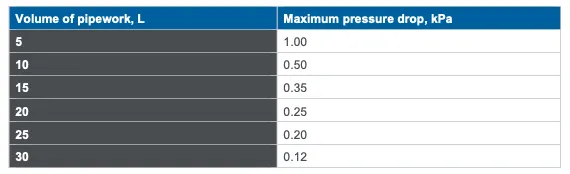
Image: energysafe.vic.gov.au
If you use LPG rules for natural gas, your pipes will be too small. Your appliances won’t get enough fuel, especially when you run a few at once.
But if you do it the other way around, you’ll end up with oversized pipes that cost you way more than you need to spend.
Pipe material changes the calculation. Each one has different internal dimensions and installation limits. A licensed gas fitter can’t just choose a pipe size first and decide on the material later.
Here are the main options you’ll find in Melbourne homes:
Keep in mind that material choice is a matter of compliance, not just pressure.
Galvanised pipe for gas is banned underground and often fails inspections. But, homes built before the 1980s likely fail current safety standards.
And from March 2025, Amendment 2 of AS/NZS 5601.1:2022 requires metallic pipe transitions for at least one metre before exiting walls and ending at least one metre from appliances when using multilayer pipe.
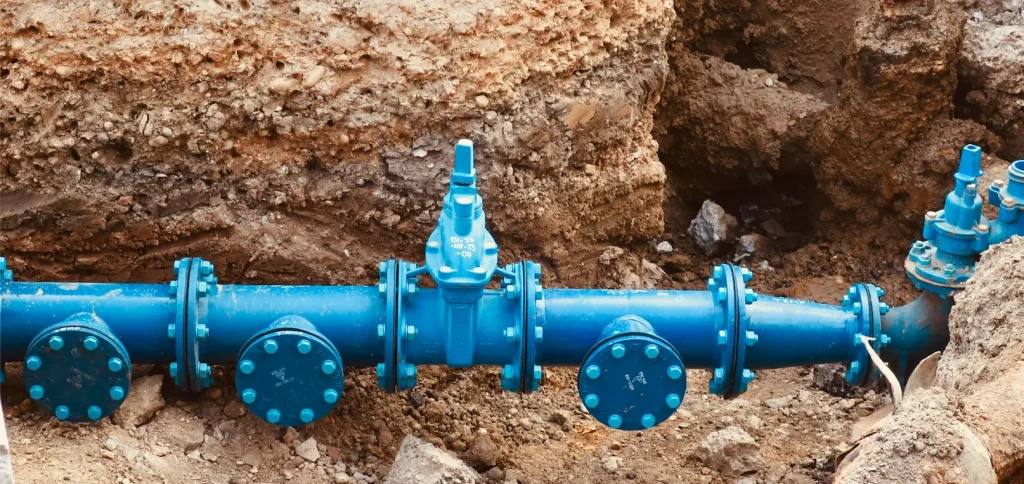
Image: Rose Galloway Green on Unsplash
Here is a simplified overview of how the process works to calculate gas pipe sizing in Australia:
It starts with your licensed gas fitter listing every gas appliance connected to the pipework. That might include a cooktop, oven, ducted heater, outdoor BBQ point, or hydronic boiler.
The fitter then checks the appliance nameplate or manufacturer’s data sheet and records how much gas each unit needs at full load.
Common residential loads look roughly like this:
| Appliance | Example Demand |
|---|---|
| Gas cooktop | 22 MJ/hr |
| Gas oven | 15 MJ/hr |
| Instantaneous hot water | 180 MJ/hr |
| Ducted gas heating | 100 MJ/hr |
| Outdoor BBQ point | 40 MJ/hr |
| Total connected load | 357 MJ/hr |
The fitter uses these numbers to find the peak demand. This shows how big the main pipe near the meter needs to be.
You don’t need this total load for every pipe. The main line carries the weight for the whole house. Smaller branches only need to handle the appliances they hook up to.
The gas fitter finds the index run. They map out the real route the pipe takes. It goes around walls, through cavities, and across roof spaces. It follows every twist and turn from past renovations.
Keep in mind, bends and fittings matter too. Per AS/NZS 5601.1:2022, the fitter must use a proper sizing method.
They usually follow the approved longest-length method, which allows for a standard 20% length addition to account for fittings, or they calculate the exact equivalent pipe length using official data tables.
For example, if the physical pipe run to a backyard hot water unit is 15 metres, adding that standard 20% fitting allowance brings the final equivalent length to 18 metres (15 x 1.2 = 18) for the lookup tables.
Once the fitter has the gas load and equivalent pipe length, they check the sizing chart. This depends on the gas type, pressure, material, and drop.
They match the flow rate with the length. The table shows the smallest pipe size to keep things steady. They just break it down and size the network section by section.
The gas line installation process follows directly from these results — what the table says is what goes in the wall.
The fitter calculates the required pipe sizes flowing downstream from the meter box out to each individual run.
Each pipe section is sized to supply only the specific cumulative load or the individual appliance it is connected to. The hot water pipe only supplies the hot water, and the cooktop pipe only supplies the cooktop.
Your gas fitter will finish the pipe sizing list for the paperwork. They must send it to the BPC within five days. This is the final check to make sure the job is done correctly.
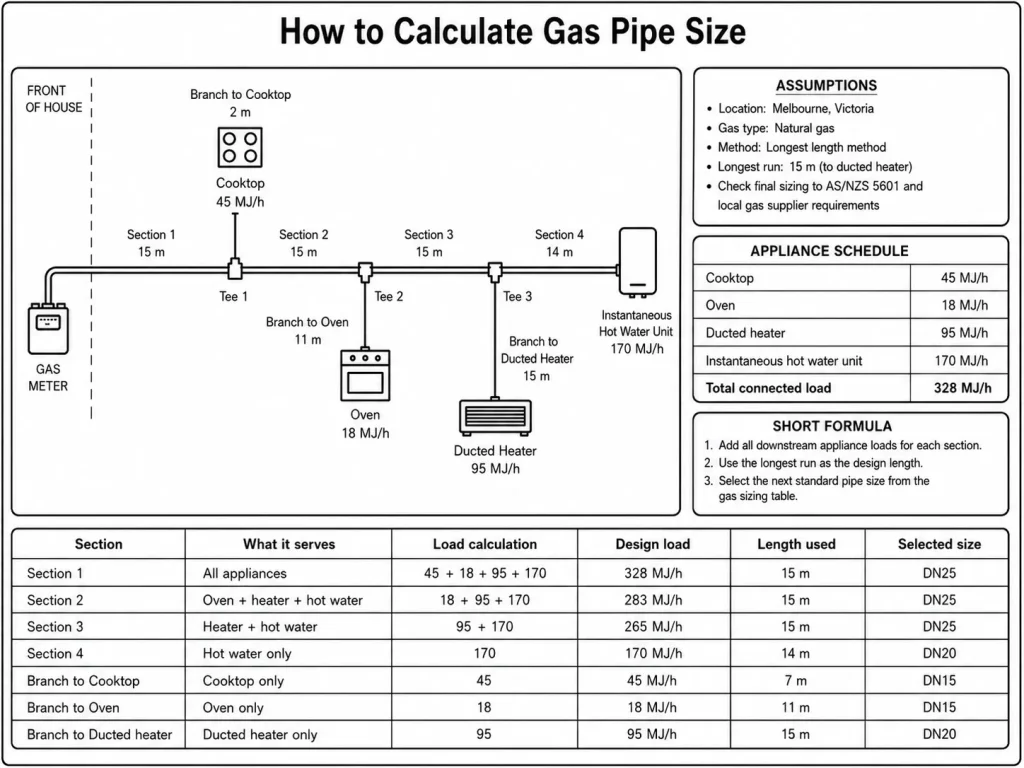
Image: freepik
Yes. Gas type changes the pipe size. Natural gas and LPG run at different pressures and carry different amounts of heat energy per cubic metre.
Natural gas, mostly methane, has an energy density of about 38.7 MJ/m³. LPG, usually propane in this context, delivers about 93.2 MJ/m³. More than double.
That means LPG gives you more heat with less gas. Natural gas needs more gas to flow through the pipes. That’s why houses with ducted heating, nonstop hot water, and a big stove often need bigger pipes.
If you have a big continuous flow hot water unit that needs 200 MJ/hr, here’s what you’ll need:
As you can see, natural gas takes up much more space to provide the same amount of energy. That’s why the pipe needs to be larger to keep the pressure right.
Specific gravity also matters. It’s how heavy the gas is compared to air, and that changes how it moves through the pipe.
Natural gas is lighter than air. Its specific gravity is about 0.60. LPG is way heavier, around 1.53, so it drags more as it flows through the pipes.
To understand how to calculate gas pipe size? Yes. To size, install, test, alter, or certify the pipework yourself? No.
You need a registered gas fitter. They are the ones who install gas lines and help you with the calculation.
This is not a grey area. Unlicensed gas work can carry serious penalties under Victorian law.
The Building Act 1993 sets maximum penalties of up to 500 penalty units for some offences. With each penalty unit costing $203.51 in 2025–26, the highest fine is over $100,000.
Then there is the practical problem. Even if your math looks right, unlicensed gas work cannot be legally signed off.
Without a proper Certificate of Compliance, the installation is non-compliant. It doesn’t matter if the pipes “seem to work fine.”
Read the process. Ask sharper questions. Understand what your gas fitter is checking. Just do not turn it into a weekend job with a wrench, a sizing chart, and misplaced confidence.
These are the gas pipe sizing questions Melbourne homeowners usually ask:
What pipe size is usually used in Melbourne homes?
Most Melbourne homes use a 25 mm main gas pipe with 15 mm or 20 mm branches. But, homes with high-demand units like continuous hot water may need a 32 mm main to keep the gas pressure steady when everything is running.
Does adding a new gas appliance mean re-sizing existing pipes?
Often, yes. A small BBQ might be fine if your system has spare capacity. But a continuous flow hot water unit (150–200 MJ/hr)? It can quickly exceed an older gas line’s limit.
A licensed gas fitter must check pipe size, appliance load, and pressure before connecting new equipment. Skip this, and your new appliance may fail the moment other heaters turn on.
How long does a gas pipe sizing assessment take?
For a standard Melbourne home, a licensed gas fitter usually assesses pipes and quotes in 30–60 minutes.
Accessibility is key. Inspections are faster when meters, appliances, and pipes are easy to reach. If pipes are hidden behind cabinets, double brick, or renovations without plans, the check takes longer.
What is AS/NZS 5601.1:2022, and which version applies?
AS/NZS 5601.1:2022 sets the rules for how gas pipes are sized, installed, and checked for safety.
Released in September 2024, Amendment 2 became mandatory on 6 March 2025. While older versions apply only in rare transition cases, Melbourne gasfitters must use this current version for standard residential work.
Can I calculate the gas pipe size myself?
You can’t legally install, change, test, or certify gas pipework unless you’re properly licensed. Knowing what your gas fitter checks like appliance demand helps you ask better questions before you approve the work.
Gas pipe sizing isn’t just picking a diameter from a chart. It depends on appliance demand, total MJ/hr load, pipe length, and pipe material. Get it right for safety and compliance with AS/NZS 5601.1:2022.
Knowing the method helps you ask smarter questions, but sizing and installation are licensed work in Victoria.
Need pipes sized for a new appliance, renovation, BBQ point, or hot water upgrade? Melbourne Gas Plumber handles the full process with licensed fitters across Melbourne.

Every week, we share practical insights based on the combined knowledge and real-world experience of our team. Our articles cover gas fitting, gas safety, appliance installation, hot water systems, maintenance and everyday plumbing issues, so you can make well-informed decisions about your gas plumbing needs.


Fill the form below and we’ll get back ASAP!

MGP! Thank you for help, honest pricing and high quality work. Thank you to Joe for pricing and the boys involved for replacing my hot water tank and fixing my gas leak for a reasonable price. 5 star response, 5 star service and 5 star price.
Joe was great. Very professional and quick. Gas hot water heater needed replacing, he was honest and upfront about what our options were. System was sourced and replaced within a couple of hours.
Fantastic service very responsive Joe is highly recommended and works very clean and neat..... good job well done....very happy... will use again and again

At Melbourne Gas Plumber, we're here to handle all your gas plumbing needs throughout Melbourne. With over 40 years of experience, we bring extensive local knowledge and expertise to every job.
QUICK LINKS
OPENING HOURS
Open 24/7