Gas fireplace pilot won’t light? That’s understandably a frustrating issue, but worry not, there are steps to fix the problem.
Could you relight the pilot gas yourself, or should you rely on a gas fitting professional? That’s also another question our in-house experts at Melbourne Gas Plumber will answer.
Before going into troubleshooting, you’ll need to understand why the trouble is there in the first place.
If the valve is turned off or the gas tank is empty, the pilot light won’t get the fuel it needs to stay lit. Ensure that the gas supply is on and that other gas appliances in your home are working properly.
A thermocouple is a small safety device that senses whether the pilot light is burning. If it’s damaged, dirty, or misaligned, it might not detect the flame correctly and will shut off the gas as a safety precaution.
Over time, dust, soot, or spider webs can clog the small pilot tube, blocking the gas flow. This leads to a weak or flickering flame that can’t stay lit. Cleaning the pilot tube with a fine brush can often fix this.
If you recently turned off the gas or haven’t used the fireplace in a while, air can enter the line. This prevents consistent gas flow to the pilot light. Bleeding the gas line carefully can help purge the trapped air so the gas flows smoothly.
Low pressure means the flame doesn’t get enough fuel to stay lit. This might happen due to issues with your gas regulator, leaking gas meter, or gas company supply. If other appliances also have weak flames, contact your gas provider.
The thermopile generates electricity from the pilot flame to power the gas valve and controls. If it’s malfunctioning or dirty, the system may not generate enough voltage to keep the pilot light on.
If your ignitor is weak or corroded, it may not produce a strong enough spark to keep the pilot light burning consistently. Replacing the ignitor can usually solve the issue.
Also Read: How to Remove Your Gas Fireplace Safely
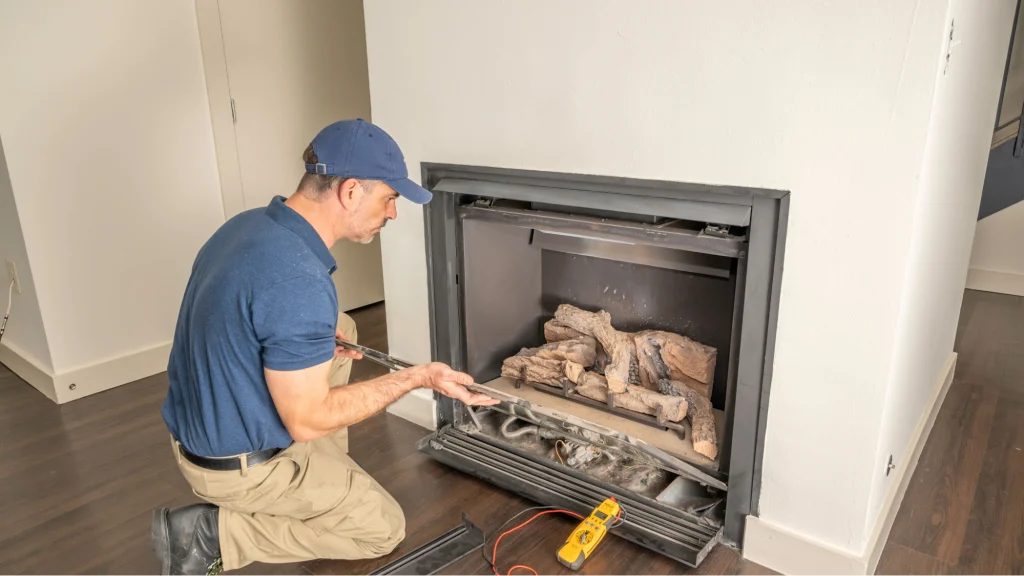
If your gas fireplace won’t light, here’s what you can do: don’t panic. This, too, shall pass. Now, try out these steps instead:
Before touching anything, switch the wall control to the OFF position. If your fireplace connects to household electricity, shut off the breaker feeding that circuit.
Take a moment to sniff around the unit. If you smell gas, stop immediately, open windows, and wait until the smell is gone before continuing. Safety always comes first; never strike a spark or hit the igniter if raw gas is in the air.
Access the pilot and controls hidden below the logs. Depending on the model, your fireplace may have a fixed glass pane or a folding door-style cover. Gently lift the glass panel up and off, placing it on a towel to avoid scratches.
Beneath the opening, remove the lower trim or kick plate. Usually, it either lifts off or tilts forward to reveal the valve assembly and ignition controls. Expect a bit of dust, cobwebs, or even old insect nests if the unit hasn’t been used in years. A quick vacuuming here already makes later steps cleaner and safer.
Locate the shutoff valve on the incoming gas pipe. It’s a small red- or yellow-handled lever.
When the handle runs parallel to the pipe, gas can flow. When it’s perpendicular, it’s off. Turn it so it’s parallel to confirm the gas is available to the fireplace.
If you’ve had recent plumbing or appliance work done, air may be trapped in the line. That’s normal and can cause a short delay when lighting the pilot later.
Find the main control knob labeled OFF, PILOT, or ON on the gas valve. Turn it to PILOT. You’ll notice that in this position, the knob can be pressed inward. This opens a small path that allows a limited gas flow only to the pilot light.
Nearby, there should be a push-button igniter. Press it once or twice to confirm that you see or hear a faint spark inside the fireplace near the pilot assembly.
A weak or missing spark means corrosion or soot buildup, which you can fix later by cleaning the electrode with a soft brush or fine sandpaper.
Press and hold the control knob firmly in the PILOT position to let gas reach the pilot tube.
While holding it down, repeatedly press the igniter until you see the flame catch. Since your fireplace hasn’t been used in years, it may take 30 seconds or more before gas displaces all the air and finally ignites.
Be patient. If nothing lights after a minute, release the knob, wait a few minutes to clear any gas, and try again.
Sometimes spider webs or dust clog the pilot opening, and a quick blast of compressed air or vacuum suction can fix that before re-lighting.
Once the pilot lights, keep holding the control knob for another 30 to 60 seconds.
The small metal probe sitting in the flame is the thermopile (or thermocouple), and it must heat up to send a low-voltage signal to the valve confirming that the pilot is stable.
Look closely at the flame color. It should be solid blue and wrap around the thermopile. Orange or yellow tips indicate dirt or a partially blocked jet.
You can lightly clean the thermopile with a fine scuff pad or 300-grit sandpaper once the system cools down, then vacuum around it to restore proper combustion.
After the pilot has been burning steadily for a minute or more, gently release the knob. If the flame stays lit, turn the control knob from PILOT to ON.
Now, flip the wall switch to the ON position. The main burner should roar to life within a second or two.
If it doesn’t, wiggle the switch and check for loose wires behind the wall plate. In many older setups, corrosion or a half-disconnected terminal can interrupt the circuit.
Tighten the screws or clean the ends, and the problem is usually solved instantly. Sometimes, you’ll even hear the burner ignite as soon as the contact is restored.
If the pilot works but the burner still refuses to light, use a multimeter to test the thermopile output. Set it to DC millivolts and touch the probes to the TP and TP/TH terminals on the valve.
A healthy thermopile generates at least 325 mV, while freshly cleaned ones often read around 400–460 mV.
A lower reading means it’s dirty or worn, and cleaning usually brings it back to life. This simple test prevents unnecessary part replacements and helps confirm that the issue lies in the wiring or switch rather than the valve itself.
When in doubt about the switch, you can short the two low-voltage terminals labeled TP/TH and TH directly on the valve using a bent paperclip or small jumper wire.
If the burner ignites, the fault lies in the wall switch or wiring. If nothing happens, check for corrosion at those valve terminals or disconnected leads.
Always perform this step carefully. These terminals carry only a few volts, but you don’t want to bend or damage them.
Cleaning and tightening connections here can often restore proper operation without replacing any components.
After confirming that the pilot and burner both work properly, turn off the fireplace and allow it to cool completely.
Remove the ceramic logs, keeping track of their order, and vacuum out the entire base, including under the pilot assembly. A cleaner firebox ensures better airflow and flame quality.
Once everything looks fresh, reinstall the logs, set the glass panel back, and secure the trim. When you relight it, you should see an even blue pilot flame and a strong, steady main flame. No flicker, no yellow tips, and no delayed ignition.
Also Read: Reasons Why Your Gas Fireplace Smells Like Gas
Here are some of the most commonly asked questions about how to light a gas fireplace that won’t light.
To manually light a pilot on a gas fireplace, remove the glass panel, ensure the gas valve is on, turn the control knob to PILOT, press and hold it while clicking the igniter until the flame lights.
Hold for 30 – 60 seconds, then release, switch to ON, and test the main burner.
If your gas fireplace clicks but produces no spark, the igniter may be dirty, misaligned, or worn out. Dust or soot buildup can block the electrode from sparking.
Check the battery (if battery-powered), clean the igniter tip with fine sandpaper, and ensure the igniter wire is connected and not damaged.
Turn off the gas and let everything cool completely. Remove the glass panel and access the pilot assembly.
Use a soft brush or compressed air to clear dust, soot, or spider webs from the pilot tube opening. For heavy buildup, gently insert a needle or thin wire to unclog it, then vacuum the area.
Relighting a pilot light isn’t usually difficult if you follow the right steps. Turn the knob to PILOT, press and hold while clicking the igniter until it lights, then switch to ON.
However, if it won’t stay lit or you smell gas, stop immediately and call a Melbourne Gas Plumber for safe assistance.
To reset a gas fireplace pilot, first turn the control knob to OFF and wait five minutes to clear any remaining gas.
Then turn it to PILOT, press and hold while pressing the igniter until the flame lights. Keep holding for 30 – 60 seconds, release, and switch to ON once it stays lit.
If your gas fireplace won’t light, simply follow the steps laid out here. However, if the issue still persists, Melbourne Gas Plumber is only one call away!

Fill the form below and we’ll get back ASAP!

MGP! Thank you for help, honest pricing and high quality work. Thank you to Joe for pricing and the boys involved for replacing my hot water tank and fixing my gas leak for a reasonable price. 5 star response, 5 star service and 5 star price.
Joe was great. Very professional and quick. Gas hot water heater needed replacing, he was honest and upfront about what our options were. System was sourced and replaced within a couple of hours.
Fantastic service very responsive Joe is highly recommended and works very clean and neat..... good job well done....very happy... will use again and again

At Melbourne Gas Plumber, we're here to handle all your gas plumbing needs throughout Melbourne. With over 40 years of experience, we bring extensive local knowledge and expertise to every job.
QUICK LINKS
OPENING HOURS
Open 24/7