How much does a gas line repair cost? A small repair may run about $200, but underground or full line replacement can reach $5,000 or more. But why is there such a big price difference?
This guide explains what affects your final price before you call our gas leak detection team in Melbourne and agree to the repair work. Keep reading!
Use this information as a guide, not a final quote. Labor and standard materials are included. After-hours fees, concrete repair, and major surface restoration are extra.
| Repair Type | Estimated Melbourne Cost |
|---|---|
| Minor gas leak repair (exposed fitting) | $150–$400 |
| Thermocouple replacement | $220–$380 |
| Cooktop igniter or switch | $260–$450 |
| Gas valve repair/replacement | $320–$700 |
| Accessible pipe replacement | $400–$900 |
| Underground line repair | $400–$1,200 (plus reinstatement) |
| Gas meter relocation | $630–$2,625 |
| Full gas line replacement | $1,500–$5,000 |
| Standard callout fee | $84–$190 |
| Emergency same-day rate | $250–$400+/hr |
| Certificate of Compliance | Statutory fee $37.20 (plus admin) |
Most Melbourne homeowners pay about $750 for a simple gas repair. This includes a new pipe section, a connector, pressure testing, and a compliance certificate.
Under the Building Act 1993, a licensed gasfitter must give you a Certificate of Compliance for any job costing $750 or more.
It’s illegal for anyone to offer a lower price to skip this safety requirement. So, always check your gasfitter’s licence and make sure your quote includes the required safety paperwork.
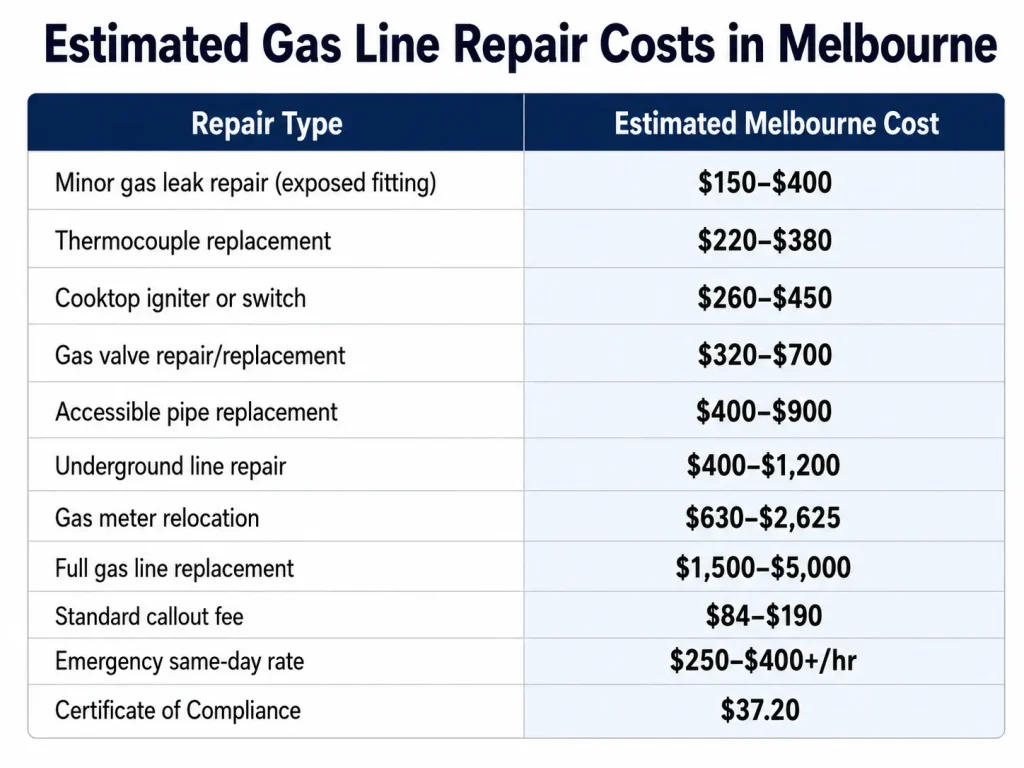
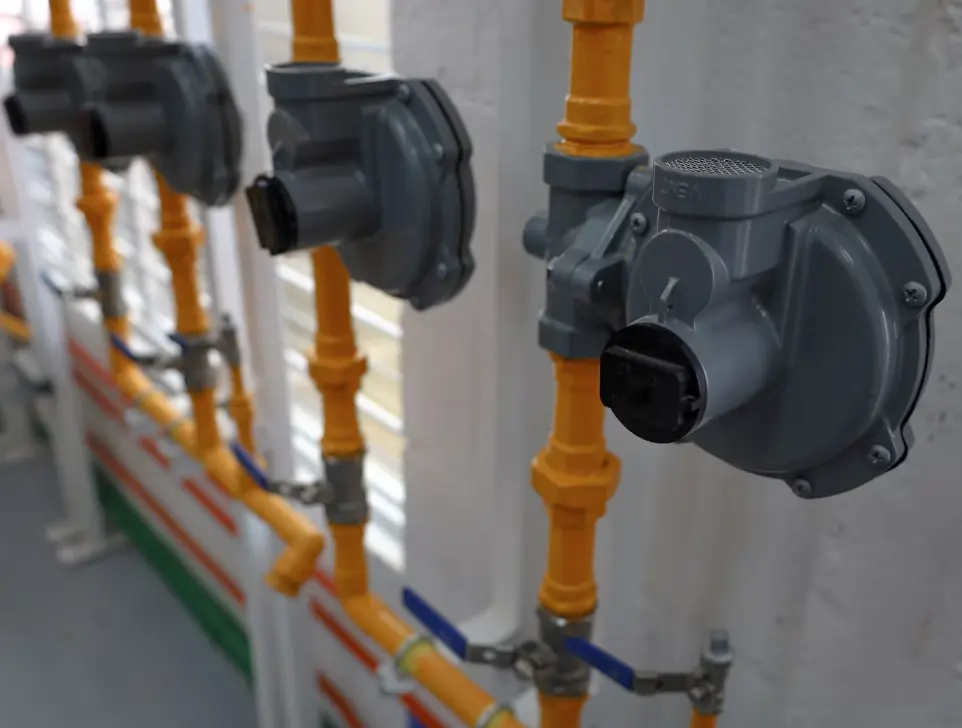
Image: Guille B on Unsplash
There are many factors that affect gas line repair costs in Melbourne. These are what drive the numbers:
A leak at an exposed bayonet fitting is one of the cheapest gas repairs. Your gas fitter shuts off the gas, reseals the joint, and tests the pressure per AS/NZS 5601.1 and ESV standards.
It takes under an hour and costs $150–$400. But, if you have a rusted pipe inside a wall, that will cost more.
The fitter must find the leak, open the wall, replace the pipe, and retest the system. So, plan for half a day for this, and note that wall repairs are a separate cost.
And if the pipe is under concrete, you must pay for leak detection, pipe replacement, and patching the slab separately.
Leak severity and difficult access cost more. Anything buried behind walls drives up the price quickly.
Exposed pipework is inexpensive because gasfitters can access issues without breaking walls or digging. For cooktops, hot water units, or appliance connections, repairs cost around $150–$400.
Wall cavities cost more. The job takes longer to prepare. The gas fitter may need to find the pipe, cut a hole in the wall, and remove the broken pipe. Replacing in-wall pipes costs $400–$900, excluding wall repairs.
Underground leaks are the most expensive. First, the fitter who understands the signs of a gas leak will find the leak. Then they have to dig, fix the pipe, test the pressure, and fix the surface.
The pipe repair alone can cost $400–$1,200. And if the pipe is under paving, a driveway, or concrete, the labor costs go up quickly.
Fixing plain concrete can add roughly $100–$130/m². Exposed aggregate can cost around $120–$200/m².
Pipe material often decides whether repair or replacement is the smarter spend.
Galvanised steel is often the problem. Common in Melbourne homes from the 1960s–1980s, it corrodes from the inside out. Rust shrinks the diameter, weakens joints.
Spending $400–$900 on a section today often leads to another repair months later. Once failing, full replacement is the better investment.
Copper can rust at the joints and in exposed areas. But, small, isolated problems are easy to fix. If the rest of the pipe is in good shape, you only need to replace the damaged part.
Black iron pipe sits in between. It stays strong for decades. But once rust starts, replacing the pipe is safer than chasing leaks. The repair looks affordable on paper.
Newer homes use CSST (corrugated stainless-steel tubing). Faster to install, easier to route, quicker to repair. That matters when Melbourne gasfitters charge $100–$200 per hour.
Standard business hours are the baseline. In Melbourne, gasfitters charge $120–$180/hour.
Evening and weekend call-outs run $180–$280/hour. Public holidays may cost double. Emergency same-day service is $250–$400/hour, with an after-hours fee of $100–$250 added.
That midnight call-out covers the cost of a licensed gasfitter stopping their night, driving to your home, isolating the risk, and making the property safe.
So, who to call for a gas leak? Make sure you choose a licensed gas plumber to do the jobs, no matter the time you book the work.
Please note, Melbourne Gas Plumber offers same-day service for calls before 10:30am. After-hours emergency response is available 24/7.
Victoria has three gas distributors, each responsible for the network up to and including your meter’s outlet coupling:
If the problem is on the distributor’s side, like their pipe, regulators, or meter, they fix it free. They’ll send an emergency team to secure a reported leak.
Everything downstream from the meter outlet is your responsibility. That’s where a licensed gasfitter and private costs apply.
Not sure which distributor covers you? Check your gas retail invoice. The distributor’s name, asset zone, and emergency line are listed.
Here’s what happens on the day, from your gasfitter’s arrival to when they hand you a paper:
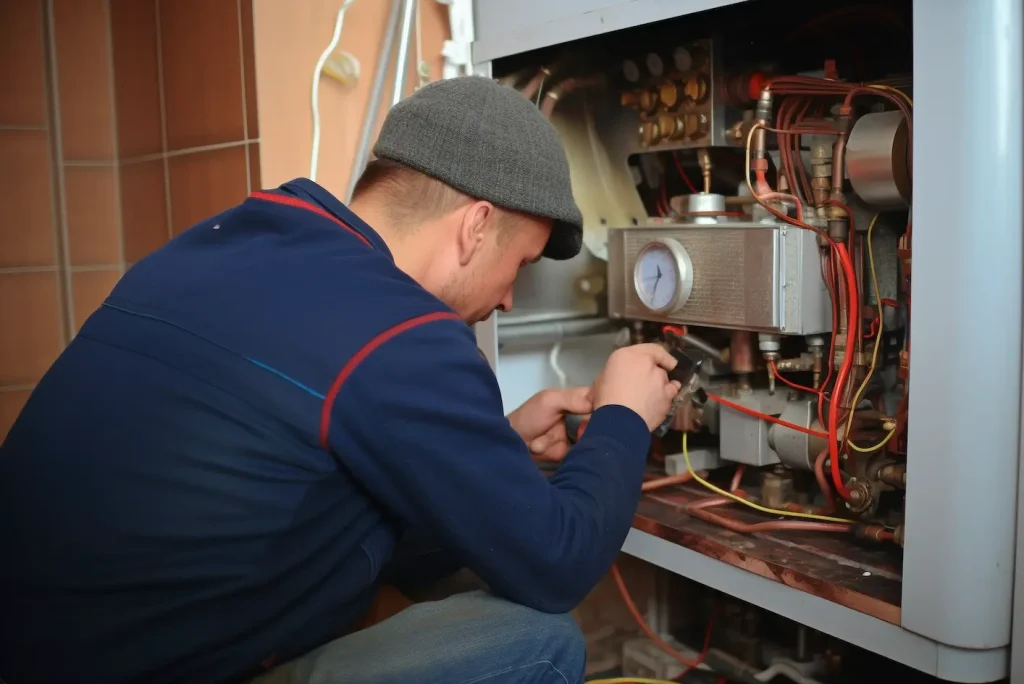
Image: tongpatong on Magnific
Sometimes the right answer is not to patch the pipe. It’s to replace the run entirely. And the clearest signs include:
Replacing a full gas line in a Melbourne home costs $1,500 to $5,000. The price depends on property size, appliance load, pipe length, and the extent of existing piping to be removed or bypassed.
While replacement costs more upfront, constant repairs end up costing you more in the long run. Plus, if fixing a leak means cutting into your walls or floors, replacing the line is often cleaner, safer, and easier to certify.
Only licensed gas fitter in Melbourne with a gasfitter endorsement from the Building and Plumbing Commission (BPC) can repair gas lines. And this is different from a standard licence.
This matters because many licensed plumbers aren’t legally allowed to work on gas. Check their licence card—just ask to see it. You can also verify any gasfitter’s licence on the BPC public registry online.
Please note, the Gas Safety Act 1997 classifies appliances into two categories:
Never try DIY gas repairs. It’s illegal under the Gas Safety Act 1997, and doing it yourself voids your home insurance.
On top of that, statutory penalties are tied to Victorian penalty units, which is $209.10. Unlicensed gas work or failing to provide compliance paperwork carries severe court-ordered penalties.
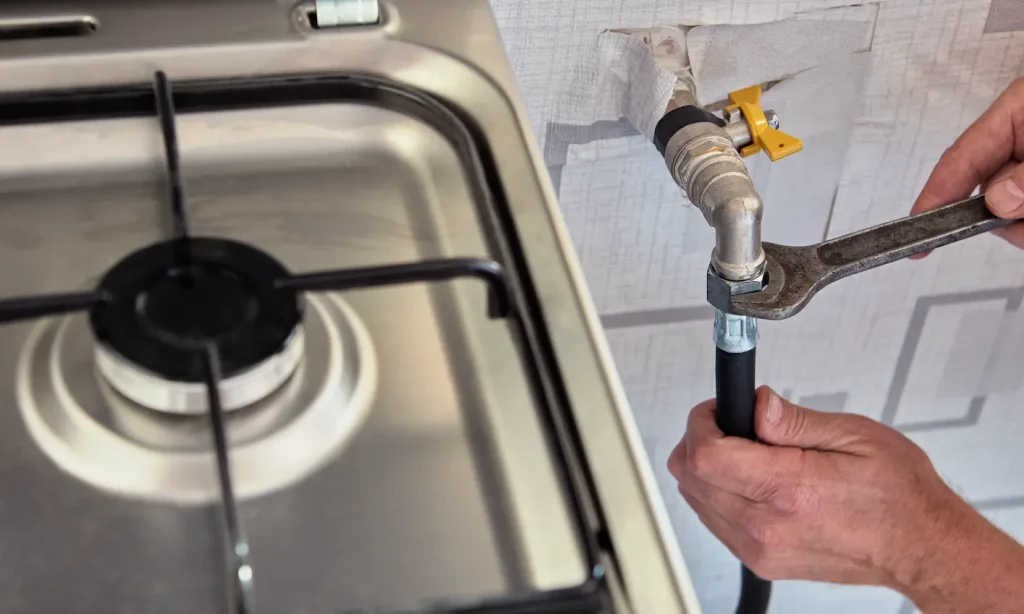
Image: evprokrey on Magnific
Most Australian home insurance policies cover sudden, accidental damage. For example, a pipe cracked by the ground sinking, soil moving and breaking a joint, and physical damage from nearby digging.
Gradual failure is different. Corrosion, rust, ageing, and wear and tear are usually excluded. If a gas pipe failed because it simply wore out, your claim will likely be rejected.
And keep in mind, your insurance covers damage from a broken pipe, not the repair itself. If a leak ruins your kitchen with fire, that damage might be covered. But, you have to pay for the pipe repair.
What about unlicensed work? This can ruin your insurance claim. Your insurer might refuse to pay.
So, before assuming a large repair bill is covered, check your PDS for definitions and exclusions. If the cause is unclear, talk to your insurer before starting any work like replacing a gas line.

Image: wayhomestudio on Magnific
These are the questions that people often ask when it comes to gas line repair costs in Melbourne.
Repair costs depend on the leak’s location. $150–$400 for appliance connections, $400–$900 for wall cavities, and $400–$1,200 for underground pipes. Surface repairs add $100–$130/m² for plain concrete or $120–$200/m² for exposed aggregate.
Most gasfitters charge a $84–$190 inspection fee during business hours, which is credited toward repairs. Emergency or after-hours visits add a $100–$250 premium to standard labor costs.
Responsibility depends on the meter side. Your gas distributor handles and fixes everything up to the meter. From the meter into your home, you are responsible for hiring and paying a licensed gasfitter for repairs.
Simple repairs or easy-to-reach leaks take one to two hours. Fixing lines inside walls or underground takes half a day to a full day. Your gasfitter will provide a precise time frame after checking the system on-site.
You must insist on a Certificate of Compliance for all gas work. Your gasfitter must file records with the Building and Plumbing Commission (BPC) within five business days, and you must receive your copy.
Gas line repair costs in Melbourne vary depending on access difficulty, pipe material, emergency call-outs, and surface reinstatement for underground work.
Price matters, but your safety matters more. Only a licensed gasfitter with a Type A gas fitting endorsement can legally repair gas lines in Victoria.
Melbourne Gas Plumber specialises in gas fitting, leak detection, and new installations across Melbourne. We offer same-day service and 24/7 emergency coverage. Contact us for a free, no-obligation quote.

Every week, we share practical insights based on the combined knowledge and real-world experience of our team. Our articles cover gas fitting, gas safety, appliance installation, hot water systems, maintenance and everyday plumbing issues, so you can make well-informed decisions about your gas plumbing needs.


Fill the form below and we’ll get back ASAP!

MGP! Thank you for help, honest pricing and high quality work. Thank you to Joe for pricing and the boys involved for replacing my hot water tank and fixing my gas leak for a reasonable price. 5 star response, 5 star service and 5 star price.
Joe was great. Very professional and quick. Gas hot water heater needed replacing, he was honest and upfront about what our options were. System was sourced and replaced within a couple of hours.
Fantastic service very responsive Joe is highly recommended and works very clean and neat..... good job well done....very happy... will use again and again

At Melbourne Gas Plumber, we're here to handle all your gas plumbing needs throughout Melbourne. With over 40 years of experience, we bring extensive local knowledge and expertise to every job.
QUICK LINKS
OPENING HOURS
Open 24/7